
19 Best Souvenirs from Portugal (A Local’s Buyers Guide)
The best souvenirs are the ones you forget you bought. They get used, they disappear into the house, and then one ordinary morning you reach for something without thinking and for a second or two you are back there.
That is a surprisingly hard thing to buy on purpose. Fridge magnets end up in a drawer. Keyrings break. The painted rooster that looked charming under shop lighting turns into one more ornament you have to dust.
Portugal happens to be very good at the other kind, because it never really stopped making things. Soap wrapped in the same lithographed paper since the 1880s. Tinned fish that will outlast the trip by a decade. A blanket woven from mountain wool. A cheese soft enough to eat with a spoon. None of it was invented for visitors, which is exactly why it survives the journey home.
Nine years of living in Lisbon have taught me which of those are worth the suitcase space, and which are quietly aimed at people who will only ever be here for four days.
So here is what to buy in Portugal, roughly in the order I would spend my own money, with the shops I actually send people to and an honest section at the end on what customs will take off you at the other end.
Disclaimer: This post contains affiliate links. If you book through these links, I may earn a small commission at no extra cost to you. This helps support Travel Boo and allows me to keep creating free content. All recommendations are based on my own experience.
Planning Your Trip to Portugal
🏨 Where to stay: Compare Lisbon hotels here. Staying in Chiado or Baixa puts almost every shop on this page within a walk.
🗺️ Tours and workshops: Browse Lisbon experiences, including tile painting and food tours that end at the shops worth buying from.
🚆 Getting around: Book trains and buses with Omio. The Lisbon to Porto train takes under three hours, and the two cities shop very differently.
Where to Buy Souvenirs in Portugal
Two rules cover most of it.
First, do not leave your shopping until the airport. Prices there are inflated and the selection is the generic end of everything on this list. Second, be a little suspicious of any shop whose interior is more photogenic than its stock. Lisbon has several that have worked out that visitors will pay a premium for a nice ceiling.
For proper Portuguese brands under one roof, A Vida Portuguesa is the reliable answer. It stocks Portuguese-made goods almost exclusively, from Ach Brito soap to Bordallo Pinheiro ceramics to Regina chocolates. In Lisbon there are three: the Chiado store on Rua Nova do Almada, which took over the old Livraria Ferin building, the large Intendente store in a former Viuva Lamego tile factory, and a small one inside the Time Out Market at Cais do Sodre. There is also a Time Out Porto store.
For bargain hunting, the Feira da Ladra in Alfama is Lisbon’s oldest flea market, with roots going back to 1272 and a permanent home at Campo de Santa Clara since 1882. Its name is usually translated as Thieves’ Market, though there is a competing theory that it comes from ladro, a bug that lives in antique furniture. Worth knowing before you plan around it: it only runs on Tuesdays and Saturdays, mornings are best, and by early afternoon the good stalls are packing up.
Outside the cities, look for the regional markets. Barcelos holds one of the country’s best-known weekly markets, and the artisan stalls at smaller town fairs are usually cheaper and better than anything in a Lisbon tourist street.
💡 Insider Tip
Look for the words feito em Portugal or a maker’s mark on the base. A lot of what is sold in tourist-street souvenir shops as Portuguese ceramic is imported and hand-finished here at best. Genuine pieces from Caldas da Rainha, Alcobaca or the Alentejo almost always carry a stamp, and the shopkeeper will happily turn one over and show you.
19 of the Best Souvenirs from Portugal
1. Cork Products

If you buy one thing in Portugal, make it cork. The country is the world’s largest producer, responsible for around half of all raw cork production globally, and most of the cork oak forest sits in the Alentejo. The bark is stripped by hand from trees at least 25 years old, then again roughly every nine years, without felling anything.
It also happens to be the ideal souvenir material. Cork is light, does not break, does not count as a liquid, and cannot be confiscated at any border.
Bags, wallets, coin purses, phone cases and sunglasses holders are the popular buys. Quality varies enormously, so handle the item first. Good cork fabric has an even grain and stitched seams. The cheap version is a thin cork veneer glued to backing fabric, and it delaminates within a year.
In Lisbon, Cork & Co on Rua das Salgadeiras, just off Bairro Alto, is the one I would send you to first. It is more expensive than the souvenir shops and you can feel why the moment you pick something up. The Cork Store on Rua do Espirito Santo is smaller and handy if you are already walking down from Sao Jorge Castle. Porto has a good spread of cork shops too, and prices there tend to be slightly kinder.
2. Azulejos (Portuguese Tiles)

Tiles are one of the things Portugal is most famous for, and they are older here than most visitors assume. The word azulejo has nothing to do with azul, the Portuguese for blue. It comes from the Arabic az-zulayj, meaning polished stone.
You have two honest options. New hand-painted tiles from a working factory, or genuinely reclaimed ones with a traceable origin.
For new, Fabrica Sant’Anna has been hand-painting since 1741. There is a showroom at Largo Barao Quintela in Chiado, and the working factory sits out in Ajuda on Calcada da Boa Hora. The factory runs a free tour, but you have to email ahead, there is only one a day, and it does not run at weekends. Viuva Lamego, founded 1849, is the other big name, now producing in Sintra and collaborating with contemporary artists and architects.
For reclaimed, Cortico & Netos is the one people mean. Four brothers selling off a stockpile their grandfather spent decades buying from Portuguese tile factories as they shut down, which means discontinued industrial stock from the 1960s onwards rather than anything chipped off a building. You buy by the single tile, they will frame a set for you in store, and they are used to packing tiles for international flights. They moved out of Mouraria a while back and are now on Rua Maria Andrade in Anjos, closed Sundays.
Pack tiles flat, wrapped, in the middle of your case with clothing above and below. They survive fine. They just do not survive being loose.
3. Tinned Fish and Conservas

By Tanya Taylor from Travels & Treasures
Do you have foodie friends? My favourite souvenirs from Portugal are tinned sardines, sardinha portuguesa, and fish pate. The cans are decorated with beautiful little scenes and come in a range of sizes, and Portuguese sardines are genuinely renowned for their flavour and quality.
They are also close to the perfect travel souvenir. The cans are airtight, so there is nothing to leak or break, and no special packing is required. I would still bury them inside a shoe or a rolled jumper, so that a rough baggage carousel does not leave you with a dented tin.
Marco’s note: two Lisbon shops get recommended constantly and they are not the same place, despite what a lot of articles imply. Conserveira de Lisboa at Rua dos Bacalhoeiros 34 is the historic one, founded 1930, still family-run, still selling its own Tricana, Prata do Mar and Minor brands over the original counter. Closed Sundays.
Further up the same street is the Comur group’s operation, which also trades as O Mundo Fantastico da Sardinha Portuguesa, the circus-themed shop with the year-labelled tins that everyone photographs. It is a genuinely fun place to walk into. It is also, by common consent among people who have bought at both, roughly double the price for comparable fish. You are paying for the packaging and the ceiling.
Silva & Feijoo, with shops on Rua de Sao Nicolau and up near the castle, is lovely but firmly on the gift-shop end of the price scale. Loja das Conservas on Rua do Arsenal is a good middle option. And honestly, any Portuguese supermarket will sell you excellent Ramirez or Nuri for a fraction of all of the above.
4. Port Wine

Hard to argue with a bottle of the country’s most famous export. A serious vintage will run into three figures, but you can pick up a very drinkable bottle for well under twenty euros, and tasting your way through the styles first is one of the best things to do in Porto.
Buy it from one of the Port houses in Vila Nova de Gaia, across the river from Porto, where you can taste before committing. Better still, head up into the Douro Valley, ideally on a tour that includes the vineyard visits, and buy at the quinta, where you will also find the table wines that never make it into export.
Of everything on this list, wine is the item you can be least fussy about where you buy. Portugal’s wine is good enough that even the supermarket shelves are worth raiding. If you want to go deeper, I have a full guide to Portuguese drinks.
One practical thing: bottles go in checked luggage, in the middle, wrapped in clothing. If you are travelling hand luggage only, buy at duty free after security instead, and check the rules if you have a connecting flight, because a sealed duty free bag bought outside the EU can be pulled at a transfer point.
5. Portuguese Soap
This is the souvenir I give people most often and the one that is missing from almost every list.
In 1887 two Germans, chemist Ferdinand Claus and importer Georges Schweder, opened Portugal’s first soap and perfume factory in Porto. After the First World War their bookkeeper, Achilles de Brito, bought the company. His family still runs it, and it still sells under two names: Claus Porto for the luxury end and Ach Brito for the everyday one. The Musgo Real men’s line dates from the 1920s.
The soaps are thick, heavily perfumed, and wrapped in reproductions of the original lithographed papers, which is most of the appeal. A single Ach Brito bar costs a few euros. A Claus Porto gift box costs considerably more and looks like it cost more still.
They weigh almost nothing, they cannot be confiscated, they do not break, and they work as a gift for people you do not know well.
Find them at A Vida Portuguesa, or at the two Claus Porto stores in Lisbon: the larger one on Rua da Misericordia, which doubles as a small museum of the brand’s history, and a second on Rua do Carmo. Both open daily. The Porto flagship is the original. Ach Brito, the cheaper line, turns up in most decent Portuguese pharmacies and supermarkets, which is where I buy it.
6. Bordallo Pinheiro Ceramics
If you have been in a Portuguese home, you have seen the swallows. Flat ceramic birds, usually in threes, climbing a wall at an angle.
They come from the factory Rafael Bordalo Pinheiro founded in Caldas da Rainha in 1884. He was a caricaturist and illustrator before he was a ceramicist, which explains a great deal about the output: cabbage-leaf tureens, lobster platters, frogs, sardines, and pieces that are funnier than tableware usually is. The factory still presses many of them from the original moulds.
A single small swallow is inexpensive and packs flat. A cabbage tureen does not, but it is the thing people notice in your kitchen a decade later. Sold at A Vida Portuguesa, at Bordallo Pinheiro’s own stores, and at the factory in Caldas da Rainha if you are heading north.
7. The Barcelos Rooster

The Galo de Barcelos is Portugal’s unofficial national symbol. Not official, despite what a lot of guides claim, but you will see it in every souvenir shop in the country.
The legend goes that a Galician pilgrim walking to Santiago de Compostela was arrested in Barcelos for a crime he had not committed and sentenced to hang. Taken before the judge, who was mid-meal, he pointed at the roasted rooster on the table and swore it would crow if he was innocent. It did. The knot had been badly tied, and the man survived.
The bright, heart-and-flower painted figurine most people picture is much more recent than the legend. It was developed in the 1950s by a Barcelos artisan named Domingos Coto and became the template everyone copied.
Honest opinion: mass-produced roosters are the closest thing on this list to a tourist trinket, and a bad one looks like a bad one. Buy from a smaller shop or from the Barcelos market itself, where you can find pieces still hand-painted by the people who made them.
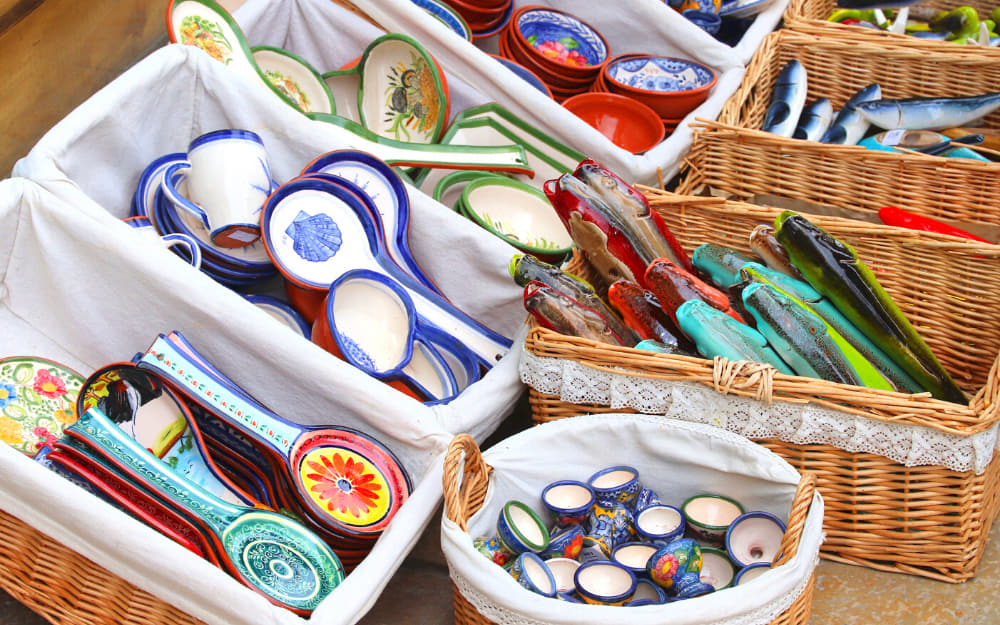
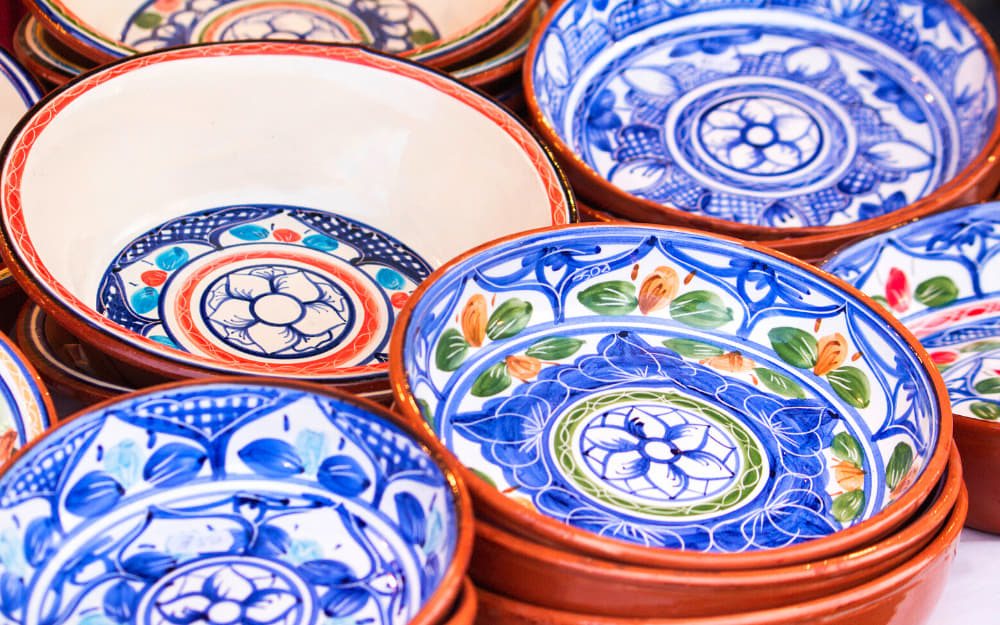
8. Portuguese Pottery and Porcelain
Worth separating two very different things that get lumped together.
Rustic hand-painted faience, the heavy earthenware plates and bowls in blues, yellows and greens, comes mostly from Caldas da Rainha, Alcobaca and the Alentejo. It is what most people mean by Portuguese pottery. Prices drop noticeably once you are off the main tourist streets, and small workshops in the Alentejo sell at a fraction of Lisbon prices.
Fine porcelain is a separate category, and Vista Alegre is the name. Founded at Ilhavo near Aveiro in 1824, it was the first porcelain factory in Portugal and it still supplies presidential and royal tables. This is not rustic tableware and it is not cheap, but a single Vista Alegre piece is a genuine heirloom.
Whichever you buy, ask the shop to wrap it properly and then wrap it again yourself. Ceramics travel badly in the middle of a soft case and very well in the middle of a hard one.
9. Olive Oil

Portuguese olive oil is consistently good and consistently underrated next to its Spanish and Italian neighbours. Alentejo and Tras-os-Montes are the two regions to look for on a label.
Buy extra virgin, buy in dark glass or tin rather than clear glass, and check the harvest date if there is one. If you took a Portuguese cooking class while you were here, or simply fell for Portuguese food, a bottle is the most direct way to keep eating it at home.
In Lisbon, Olistori on Rua da Madalena is the specialist stop and it is better than that makes it sound. They run tastings, walking you through oils from different regions so you can work out what you actually like before you buy, which is not something a supermarket shelf can do for you. They will also ship.
If you skip the tasting, a supermarket will still do you proud. A tin travels better than a bottle in any case, and either way it is checked luggage only.
10. Piri Piri

By Paulina from Paulina On The Road
Piri piri is a small, fierce chilli, and the sauce made from it is one of the most useful things you can carry home from Portugal. It adds a kick to almost anything and it is cheap.
The history is more tangled than most people expect. Chillies are native to the Americas, not to Africa or Europe. Portuguese navigators carried Capsicum frutescens to their territories in southern Africa, principally Mozambique and Angola, where it thrived and picked up the name piri piri, from a Bantu word meaning roughly “pepper pepper”. It came back into Portuguese cooking from there, which is how a South American plant ended up defining a Portuguese dish.
Bottled sauce travels easiest and is sold in every grocery store. Dried whole chillies and piri piri salt are lighter still, and you will find them at market stalls across the Algarve and the Alentejo.
11. Portuguese Cheese

Portugal makes superb cheese, and its best is a sheep’s milk cheese from the mountains.
Queijo Serra da Estrela DOP is the one to know. It is made from raw sheep’s milk and set with thistle flower rather than animal rennet, which makes it suitable for vegetarians and gives it a faint herbal bitterness. Young, it is almost spoonable, and the traditional way to serve it is to cut the top off and scoop. Aged 120 days it becomes Serra da Estrela Velho, firmer and much stronger. Queijo de Azeitao is the smaller, softer cousin from near Setubal, made the same way.
Now the part nobody tells you. Cheese is the hardest thing on this list to get home, and for some readers it is impossible. Read the Getting It Home section below before you buy a wheel of anything. If you can take it, pick a harder, aged cheese, buy it on your last day, and pack it in checked luggage.
12. Pasteis de Nata
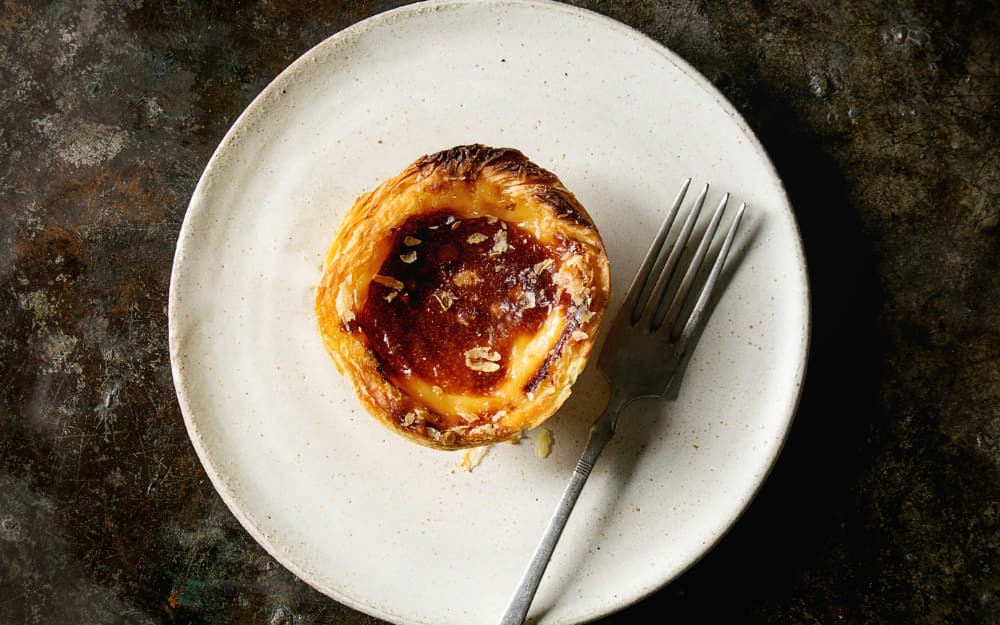
Not a souvenir that lasts, but a very good one for the first day home.
Most bakeries sell them in six-packs designed to travel. The originals come from Pasteis de Belem, which has been baking to a recipe from the neighbouring Jeronimos monastery since 1837, three years after the monastery was closed in the wake of Portugal’s liberal reforms. Only a handful of people know the full recipe, and the shop turns out something in the region of 20,000 tarts a day.
The queue reflects that. If you would rather not spend forty minutes in it, Manteigaria is my honest alternative and, for what it is worth, I think it is better. Either way, buy them last, eat them within two days, and do not expect them to survive being crushed under a Vista Alegre platter.
13. Tea Towels, Linens and Embroidered Textiles
By Nancy Michelle Cote from Ericeira Family Adventures
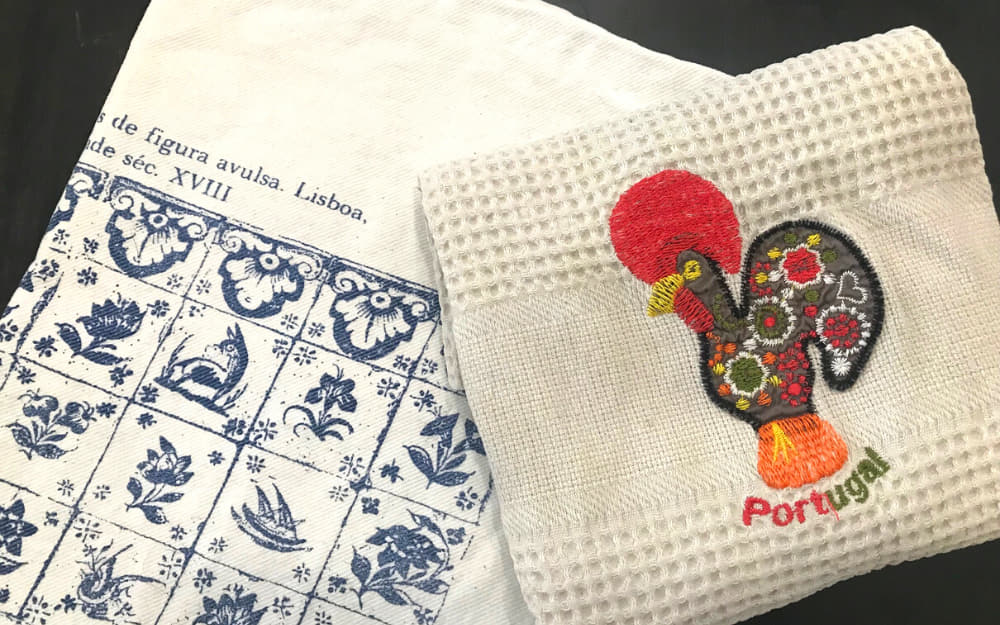
One of the most practical and useful souvenirs from Portugal is a beautiful tea towel or hand towel from A Vida Portuguesa. They are lightweight, so they add almost nothing to your luggage on the way home, they are genuinely Portuguese products, and the designs are lovely enough that you remember the trip every time you dry a plate.
The shop sources from Portuguese makers wherever it can, and the textile side goes well beyond tea towels. You will find hand-embroidered and cross-stitch designs on bread bags and snack bags, napkins and placemats, plus blankets and table linen.
Each store is an experience in its own right and easily worth an hour of browsing. The Intendente store is the big one, occupying a former Viuva Lamego ceramic tile factory, and it is full of things you will not see anywhere else.
Marco’s note: A Vida Portuguesa’s original Chiado shop on Rua Anchieta, the one with the old apothecary cabinets, closed at the end of 2023. The brand reopened in Chiado inside the former Livraria Ferin building on Rua Nova do Almada, which is larger and keeps a bookshop section at the entrance. There are three Lisbon stores now, plus one in Porto.
14. Burel Wool
Burel is a dense, felted wool cloth that shepherds in the Serra da Estrela mountains have worn for centuries. It is woven, then pounded and scalded so the fibres tighten into something almost weatherproof. Traditionally it came in whatever colour the sheep were.
By the 2000s cheap imports had killed off nearly every mill in the region. In 2011 a couple who had built a hotel nearby bought the last one, Lanificios Imperio in Manteigas, out of insolvency, kept its nineteenth-century looms and, crucially, kept the weavers who knew how to run them. Then they started dyeing burel in colours no shepherd would have recognised.
The result is blankets, cushions, bags, slippers and coats that look modern and are built like workwear. There is a shop on Rua Serpa Pinto in Chiado, one in Porto, and the factory in Manteigas runs tours if you are in the mountains.
A blanket is bulky and not cheap. A pair of burel slippers or a small cushion cover is neither, and gives you the same thing in miniature.
15. Filigree Jewellery
Portuguese filigrana is fine gold or silver wire twisted and soldered into openwork, and the best of it comes from the north, around Gondomar and Povoa de Lanhoso.
The form everyone recognises is the Coracao de Viana, the Viana heart, a large flame-topped heart that appears in traditional Minho costume and now on everything from earrings to keyrings. Gold filigree is expensive. Silver is far more affordable and looks nearly identical at arm’s length.
Jewellery is the most luggage-efficient souvenir there is, which is worth remembering if you have already committed your suitcase to ceramics. Buy from a proper jeweller rather than a souvenir stand, and check for a hallmark.
16. Madeira Wine

By Joanna from The World In My Pocket
Madeira wine makes a wonderful souvenir, especially if you buy it on the island itself. You will find it all over Portugal, but it is far better to taste first and then buy direct from the producer in Madeira.
A Madeira wine tasting is one of the best things to do on the island. Several producers welcome visitors, and Blandy’s is the most accessible, with its lodge right in the centre of Funchal. Founded in 1811 by John Blandy, it is the only Madeira house still owned and run by its founding family, now in the seventh generation. The oldest company in the trade is Cossart Gordon, which dates to 1745.
What makes Madeira unlike any other wine is that it is deliberately heated and oxidised, a technique that started by accident when barrels crossed the tropics as ballast and came back better. There are two methods today. Estufagem heats the wine in tanks to between 45 and 50 degrees for at least three months and is used for entry-level bottles. Canteiro, used for the good stuff, ages the wine in oak casks in the warm attics of the lodge, heated only by the sun, for a minimum of two years and often decades.
Many people know Madeira only as a dessert wine, but it also works as an aperitif. There are four noble varieties running from dry to sweet: Sercial, Verdelho, Bual and Malmsey. Visit a lodge in Funchal, taste across the range, and you will work out quickly which one you want to take home. Those are also the best places to buy.
17. Madeira Embroidery
Bordado Madeira is hand embroidery on linen, silk, organdie or cotton, worked in raised stitches and cutwork, usually white on white. It has been made on the island for around 150 years and it is still done entirely by hand, by roughly 3,000 embroiderers working for about thirty companies.
A tablecloth takes weeks. Some take months. That is reflected in the price, and it is exactly why the counterfeits exist.
Here is the test, and it is a simple one. Genuine Madeira embroidery carries a holographic guarantee seal issued by IVBAM, the regional wine, embroidery and handicrafts institute, which inspects every certified piece. No hologram, no certification. Machine-made pieces sold as handmade are common in the shops nearest the cruise berths, so buy from an established embroidery house in central Funchal instead. Bordal and Patricio & Gouveia are the two names that come up most, and both let you watch the work being done.
18. Poncha from Madeira
By Jasmine from The Life Of A Social Butterfly
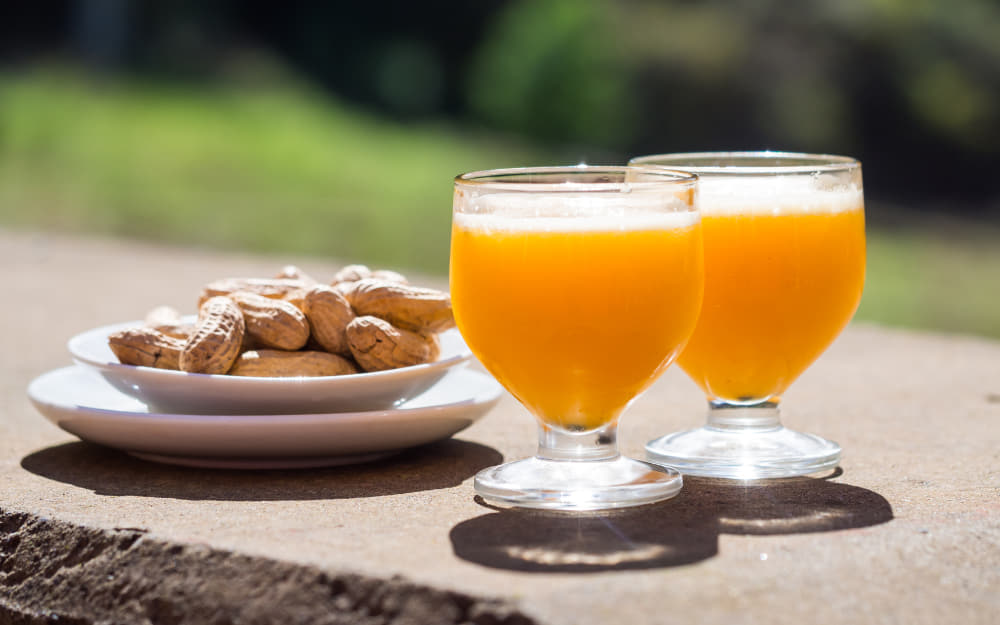
You may know Madeira wine, but the other local drink you have to try on a trip to Madeira is poncha, the island’s most famous cocktail.
It looks deceptively like fruit juice, and it does contain fruit, usually orange, lemon, tangerine or passion fruit depending on the version you order. What it also contains is aguardente de cana, sugarcane spirit, along with honey and sugar, which gives it a considerable kick. Lemon is the traditional flavour, and the drink is said to have started with Madeiran fishermen.
One of the best places to try it is the Madeira Rum House, next to the Santiago Fortress in Funchal. Once you have, you will probably want a bottle, and there are plenty of shops in central Funchal selling it. Buying at the airport is a reasonable alternative, since it will be wrapped as a duty free item.
19. Pico Island Wine

By Ines from Random Trip
Portugal is a country of remarkable wine, with the Douro and Port the most famous internationally. But have you heard of Portuguese volcanic wine? It is made in genuinely harsh conditions on Pico, one of the nine Azorean islands.
Vines here are planted straight into cracks in the lava rock and grown inside currais, thousands of small rectangular plots walled in black basalt. The walls shelter the vines from Atlantic wind and salt spray while the dark stone holds the sun’s heat, creating a warm pocket in an otherwise brutal environment. Some were built around five hundred years ago. The landscape they form has been a UNESCO World Heritage Site since 2004.
Verdelho is the historic grape, and the whites are crisp, mineral and faintly saline. You can walk the vineyards on the Criacao Velha trail, and learn the history at the wine museum in Madalena. To taste and buy, Cella Bar, the Azores Wine Company and the Pico winemakers’ cooperative are all worth your time.
If you cannot make it to the Azores, some bottles turn up on the mainland at Azorean specialist grocers in Lisbon and Porto. It remains one of the rarest things you can carry home from Portugal.
Pico Mountain, incidentally, is Portugal’s highest point at 2,351 metres, and climbing it is the island’s other main draw.
💡 Insider Tip
Please do not buy loose antique tiles from flea market stalls unless the seller can tell you where they came from. Portugal has a long-running problem with azulejos being stripped from the walls of abandoned buildings and sold to visitors. The police have run a project called SOS Azulejo since 2007, with a public database of stolen tiles at sosazulejo.com, and registered thefts have fallen by around 80% since. It is still worth asking. A genuine reclaimed tile has a documented origin. A stolen one usually has mortar still stuck to the back.
Getting It Home: What Customs Will Actually Let You Keep
This is the section most souvenir guides skip, and it is the one that costs people money. Rules changed significantly in recent years and a lot of published advice is out of date. Please make sure to do proper research and check up to date details beforehand.
If you are flying to the UK: since 12 April 2025, travellers cannot bring meat or dairy from any EU country into Great Britain for personal use. That includes cheese. It includes cured meats. It includes a sandwich. It applies whether the item is vacuum-packed, commercially sealed or bought in duty free, and penalties can reach £5,000 in the most serious cases. The measure was introduced in response to foot-and-mouth disease in Europe and it remains in force. Northern Ireland, Jersey, Guernsey and the Isle of Man are outside the restriction. Rules can change, so check the current GOV.UK guidance before you fly.
If you are flying to the US: solid cheese is generally admissible provided it contains no meat and is not a cheese that pours, so no ricotta and no cottage cheese. Meat and anything prepared with meat is not admissible. Oils, honey, packaged spices, coffee, tea and bakery items are generally fine. Declare everything on your customs form. Declaring a prohibited item means surrendering it; failing to declare it can mean a fine.
If you are staying in the EU: none of the above applies and you can carry what you like within reason.
Liquids, for everyone: wine, Port, poncha and olive oil all go in checked luggage. If you are travelling with hand luggage only, buy after security. Anything over 100ml in your cabin bag will be taken at the gate regardless of how well it is wrapped.
The safest food souvenirs on this page, from a customs point of view, are tinned fish, olive oil, piri piri sauce and anything that started life as a plant. The riskiest is cheese.
What I Would Skip
Three things, briefly, because a list of what to buy in Portugal is not much use without them.
Beach sand. You will find this recommended online as a free, eco-friendly souvenir. It is neither. Portugal’s Maritime Authority prohibits the removal of sand, stones and other geological material from beaches, and coastal erosion is a real and worsening problem here. Take a photograph instead.
Loose antique tiles with no provenance. See the tip above.
Anything bought at the airport that you could have bought in town. Cork, soap, tinned fish and ceramics are all sold airside at a serious markup and in the most generic versions available. Buy at the airport only if you ran out of time or you need a sealed bottle of something.
Where to Stay for the Best Shopping
Almost everything in this guide is walkable if you base yourself well.
In Lisbon, Chiado puts you within a few minutes of A Vida Portuguesa, Fabrica de Sant’Anna’s showroom, the Burel shop on Rua Serpa Pinto and Claus Porto. Baixa is a slightly cheaper alternative and closer to Conserveira de Lisboa and the Time Out Market. If you want the Feira da Ladra on your doorstep, skip Alfama or Graca, it is tempting but be honest with yourself about the hills and the luggage. You could much rather catch a cheap cab service to get to the market instead!
In Porto, stay around Baixa or Bolhao for the shops, and cross to Vila Nova de Gaia for the Port houses.
Compare accommodation in Lisbon here and for Porto here.
What is the most popular souvenir from Portugal?
Cork products and azulejo tiles are the two most bought souvenirs, followed by tinned sardines and Port wine. Cork is the most practical of the four: it is light, unbreakable, not a liquid, and there are no customs restrictions on it anywhere.
Can I bring Portuguese cheese home?
It depends where you are going. Travellers cannot bring any EU dairy, cheese included, into Great Britain for personal use under restrictions in force since April 2025, with fines of up to £5,000. The US permits solid cheese that contains no meat and does not pour, provided you declare it. Within the EU there is no restriction. Check current government guidance before you buy, as these rules change.
Is it legal to buy antique azulejo tiles in Portugal?
Buying reclaimed tiles from a reputable dealer with documented provenance is perfectly legal. Buying loose antique tiles of unknown origin is a problem, because many are stripped from historic buildings. Portugal’s police run the SOS Azulejo project with a public database of stolen tiles. Buy from an established shop, or buy new hand-painted tiles from a working factory instead.
Where is the best place to buy souvenirs in Lisbon?
A Vida Portuguesa is the single best stop for Portuguese-made goods across categories, with stores in Chiado, Intendente and the Time Out Market. For tinned fish go to Conserveira de Lisboa in Baixa, for tiles to Fabrica de Sant’Anna or Cortico & Netos, and for bargains to the Feira da Ladra flea market, which runs on Tuesdays and Saturdays only.
Can you take wine and Port back in hand luggage?
No, not unless you buy it after security. Bottles exceed the 100ml cabin liquid limit and will be confiscated at the gate. Pack wine, Port, poncha and olive oil in checked luggage, wrapped in clothing in the centre of the case, or buy at duty free airside instead.
Are souvenirs cheaper in Lisbon or Porto?
Porto is generally a little cheaper for cork and ceramics, and it is the obvious place to buy Port. Lisbon has the wider selection and the specialist shops. Both are more expensive than buying directly from workshops and regional markets in the Alentejo or the north.
Before You Go
One last practical thought. Almost everything on this list is heavier or more fragile than it looks, and the single most common mistake I see is people arriving with a full suitcase and no plan for the return leg. If you know you want ceramics, travel out with room to spare, or budget for a cheap soft holdall to check on the way back.
It is worth thinking about this alongside the rest of your packing, so if you have not sorted that yet, my Portugal packing list covers what to bring and, just as usefully, what you can leave at home to free up the space.
Final Thoughts
The best souvenirs from Portugal are the ones the country was already making before anyone came to visit. Cork that has been stripped from the same trees for generations, soap wrapped in the same lithographed paper since the 1880s, swallows pressed from moulds cut in 1884, tiles painted by hand in a factory that predates the 1755 earthquake.
Buy one of those and you are not buying a memento of Portugal. You are buying a small working piece of it, which is a considerably better thing to have on a shelf.
Boa viagem, and leave a bit of room in the case.

