18 Best Souvenirs from Germany: What to Buy in Germany
Every time I travel somewhere new, I love come home with something memorable. Not a fridge magnet or a keyring, but a small trinket with a bit of a story behind it, the kind of object that earns a place on a shelf and still conjures up happy memories five years later.
Over the years that has given us souvenirs from Spain, Greece, Portugal, Italy and France, and a shelf at home that reads a little like a travel diary.
Germany turned out to be unusually good at this. On my first trip to Germany I went looking for the usual tourist-shop fare and found something else entirely. Cities with their own ceramics. A perfume you can still buy at the address where it was invented. Wooden figures carved by families who have been doing it for two hundred years.
So I asked a group of travel writers who know the country far better than I do to each pick the one thing they would bring home, and added a few of my own. Here is what to buy in Germany, and exactly where to find it.
This post contains affiliate links. If you book through these links, I may earn a small commission at no extra cost to you. This helps support Travel Boo and allows me to keep creating free content. All recommendations are based on my own experience.
Planning Your Trip to Germany
🏨 Where to stay: compare hotels across Germany with Stay22
🎟️ Tours and experiences: browse top-rated options on GetYourGuide
🚆 Trains, buses and flights: compare routes and prices with Omio
🚗 Car hire: compare rental deals with Discovercars
18 Best Souvenirs from Germany
1. A Christmas Market Mug

By Stephanie from The Unknown Enthusiast
Germany’s Christmas markets run from the end of November until around Christmas, and they are one of the things Germany is best known for. Every city has one. Most have several.
Buy a hot drink at any of them and it arrives in a ceramic mug rather than a paper cup. Glühwein if you want the mulled wine, heiße Schokolade for hot chocolate, or Kinderpunsch if you would rather skip the alcohol. You pay a deposit of roughly three to five euros on the mug, which you get back when you return it. Or you keep the mug and forfeit the deposit, which is the whole point.
What makes them worth collecting is that every market designs its own, and the design changes each year. The Cologne Christmas market is the one to target if you want variety, because the city runs several separately themed markets and each has its own mug. The angel market’s mug has angels on it. The woodland-themed one has gnomes.
They are breakable, but they survive a carry-on easily enough if you wrap them properly.
💡 Insider Tip: German Christmas markets are still largely cash-only, so carry euros in small notes and coins. And if you are collecting several mugs, slide each one into a spare sock before packing it. It works better than bubble wrap and takes up no extra space.
2. A Cuckoo Clock from the Black Forest

By Soujanya from The Spicy Journey
The cuckoo clock comes from the Black Forest, and it is still made there. The town of Triberg is the centre of it, and is home to two competing contenders for the title of world’s largest cuckoo clock, which tells you something about how seriously the region takes this.
There are two things to know before buying. The first is the mechanism. Quartz clocks run on batteries, start at around fifty euros, and often play a tune. Mechanical clocks are weight-driven, need winding every day or every eight days depending on the movement, and start closer to a hundred and fifty euros. Hand-carved mechanical pieces run well into the thousands.
The second is transport. They usually come boxed with very little padding, so either repack them yourself or take the shop up on shipping, which most of the larger Triberg dealers offer.
💡 Insider Tip: Look for the VdS certificate (Verein die Schwarzwalduhr). It is the Black Forest Clock Association’s mark and it certifies that the clock was actually made in the region rather than imported and relabelled. Genuine sellers display it openly and will hand you the paperwork with the clock.
3. A Beer Stein
By Nicholas from The World Overload
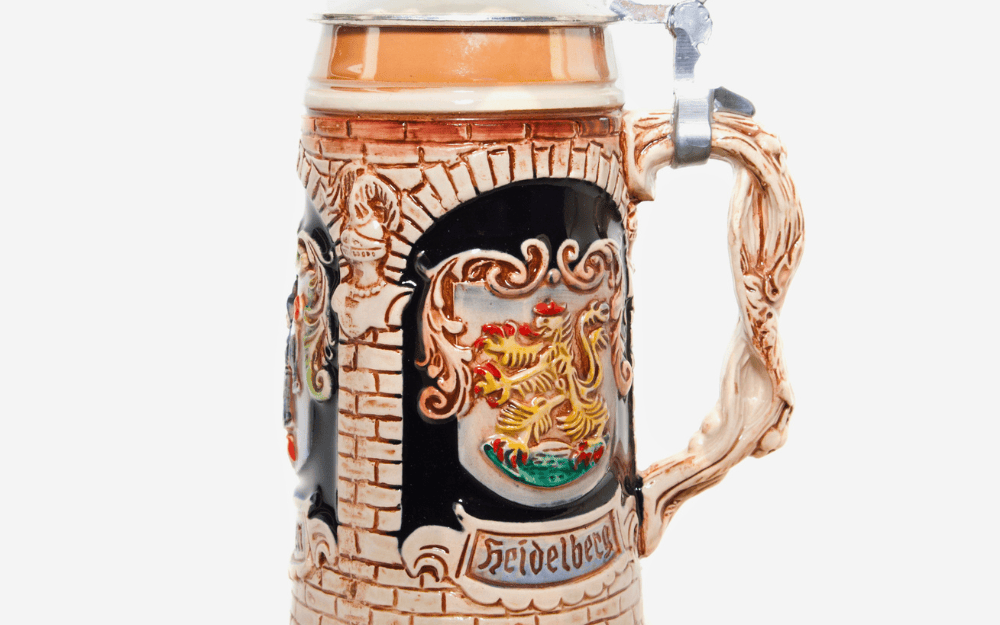
Beer is not a small thing in Germany, and the stein is the object that goes with it. What lifts it above the obvious souvenir is how much the designs vary by region. Bavarian steins lean into hunting scenes and alpine motifs, Rhineland ones toward city crests and cathedral silhouettes, and most towns of any size have something specific to themselves.
Worth knowing what you are actually buying. Traditional steins are salt-glazed stoneware, usually with a hinged pewter lid, and a decent one runs somewhere between thirty and eighty euros. Pewter-lidded stoneware from established makers like Zöller & Born or Thewalt sits at the higher end of that. Below about fifteen euros you are almost certainly looking at imported ceramic with a printed transfer rather than anything made locally, so check the base for a maker’s mark and a “Made in Germany” stamp before you commit.
Bars and breweries often sell their own branded versions, which are usually cheaper than the souvenir shops and considerably more interesting. They travel well too, which is more than can be said for most of this list.
4. Eau de Cologne, Bought in Cologne

By Kenny from Knycx Journeying
Cologne sits on the Rhine and has the heritage sites, the landmarks and the museums you would expect of a city that size. It also gave its name to an entire category of perfume, which almost no other city can claim.
There are two places to buy it, and they are not the same company, which trips up a lot of visitors.
Farina is the original. Giovanni Battista Farina founded the business in July 1709, his brother Giovanni Maria created the fragrance, and the company has been at the Farina House on Obenmarspforten since 1723. It is the world’s oldest fragrance manufacturer and the building now doubles as Cologne’s Fragrance Museum, so you can tour it and buy at the source. Look for the red tulip on the label.
4711 is the famous one. Wilhelm Mülhens started selling Eau de Cologne on Glockengasse in 1799, and after a long and fairly entertaining legal fight with the Farina family the brand settled on the house number as its name. The Echt Kölnisch Wasser formula has been unchanged for more than two centuries. The flagship store at Glockengasse 4 has a cologne fountain by the door that you are welcome to use.
Both do small gift sets that are ideal for bringing several back at once, and both are a five-minute walk from the cathedral.
Visiting Germany Over the Festive Season?
Cologne runs some of the most atmospheric Christmas markets in the country, spread across the old town, and a guided visit is the easiest way to cover several in an evening.
🎄 Browse Cologne tours and Christmas market experiences on GetYourGuide
5. Erzgebirge Wooden Christmas Decorations
This is the one I would send you after if you only had time for a single stop. The Erzgebirge, the Ore Mountains along the Czech border in Saxony, was a silver and tin mining region for centuries. When the mining wound down in the late 1700s, the miners turned to woodturning to survive the winters, and that is where the folk art comes from. The mining imagery in the carvings is not decorative. It is autobiographical.
What comes out of it: nutcrackers, Räuchermännchen (incense smokers, little figures that puff smoke from a cone burning inside them), Schwibbögen (the arched candle bridges you see in windows all over eastern Germany in December), and Weihnachtspyramiden, the tiered pyramids driven by a propeller that the candle heat turns.
The village of Seiffen is the heart of the trade, along with Olbernhau and Marienberg nearby, and it is worth the detour if you are anywhere near Dresden or Chemnitz. Seiffen has a toy museum, an open-air museum and workshops you can watch people work in. If you cannot get out there, the Christmas markets in Dresden and Leipzig carry a good range in season, and specialist shops in the larger cities stock it year-round. Käthe Wohlfahrt, the Christmas chain headquartered in Rothenburg ob der Tauber, is the easiest option if you are in western Germany, though the selection is narrower and the prices higher than buying at source.
Prices reflect the labour. A small smoker runs twenty to forty euros, a decent nutcracker sixty upwards, and a large hand-turned pyramid can reach several hundred. Anything suspiciously cheap is almost certainly imported.
💡 Insider Tip: Look for the “Echt Erzgebirge – Holzkunst mit Herz” mark, a small hallmark used by members of the regional craftsmen’s association. It is the difference between a piece turned in a Seiffen workshop and a lookalike made somewhere else entirely. The Christmas markets sell plenty of both, side by side, at not very different prices.
6. A Bottle of German Riesling

Germany produces around 40 percent of the world’s Riesling, and the good stuff is dramatically cheaper and more widely available at home than it is anywhere else. If you buy one thing on this list to actually consume, make it this.
The reason more people do not is that German wine labels have a reputation for being impenetrable. They are not, once you know that two separate things are being described.
The first is ripeness at harvest, the Prädikat. In ascending order: Kabinett, Spätlese, Auslese, Beerenauslese, Eiswein and Trockenbeerenauslese. The common mistake is reading this as a sweetness scale. It is not, at least not until the top two, which are always sweet because there is too much sugar for the yeast to finish the job. A Spätlese can be bone dry.
The second is how sweet the finished wine actually tastes, and that is a different word on the label. Trocken means dry. Halbtrocken means off-dry. Feinherb is an informal term with no legal definition that sits somewhere between the two, and is often where the most interesting bottles are. If none of those words appears, expect some sweetness balanced against the acidity, which is the classic style and much better with food than it sounds.
Where to buy: the Mosel for the light, low-alcohol, slate-driven style, and the Rheingau for something fuller. Both are easy day trips, from Trier or Koblenz for the Mosel and from Wiesbaden or Rüdesheim for the Rheingau, and estates along both rivers sell direct at prices no shop can match. If you are not going to a wine region, any decent Weinhandlung in a German city will stock far better than the supermarket.
Riesling is also only the beginning of what is worth drinking here. We have a whole guide to German drinks you should try if you want to go further.
💡 Insider Tip: Look for an eagle holding a bunch of grapes on the capsule or the label. That is the mark of the VDP, an association of roughly 200 of the country’s best estates that has been running since 1910 and holds its members to stricter rules than the law requires. Their top dry wines are labelled Grosses Gewächs, usually shortened to GG. It is the single fastest way to find a good bottle in an unfamiliar shop.
7. Marzipan from Lübeck
Lübecker Marzipan has carried EU protected geographical status since 1996, so the name can only be used for marzipan made in and around the city. It is not a marketing claim, it is a legal one, and it comes with a recipe rule: Lübeck Marzipan can be no more than 30 percent sugar, and Lübeck Fine Marzipan no more than 10 percent. Everything else is almonds. That is why it tastes less cloying than the supermarket stuff you get at home.
Niederegger has been making it since 1806 and is the name everyone knows. Their café and shop opposite the Rathaus in Lübeck is the full experience, complete with a marzipan salon upstairs, but you do not need to go to Lübeck to buy it. Niederegger is stocked in supermarkets and department stores nationwide, and the classic dark-chocolate-covered loaf travels perfectly.
If you are buying as a gift, the assorted boxes of small filled pieces are the safer choice than a single flavoured loaf. Not everyone wants an entire block of orange marzipan.
8. Lebkuchen
By Shireen from The Happy Days Travels
Lebkuchen is a soft, spiced, gingerbread-adjacent biscuit, most associated with Christmas but sold year-round at markets, particularly in Nuremberg, which considers itself the home of the good stuff and is not entirely wrong about that.
Nürnberger Lebkuchen has held EU protected geographical status since 1996, so the name can only be used for gingerbread actually baked in the city. The top grade within that is Elisenlebkuchen, which by law contains at least 25 percent nuts and no more than 10 percent flour. The best Nuremberg bakeries push the nut content close to 50 percent, and some use no flour at all. It is a noticeably better biscuit than the mass-market kind and worth paying the difference for, so check the packet for the word Elisenlebkuchen rather than just Lebkuchen.
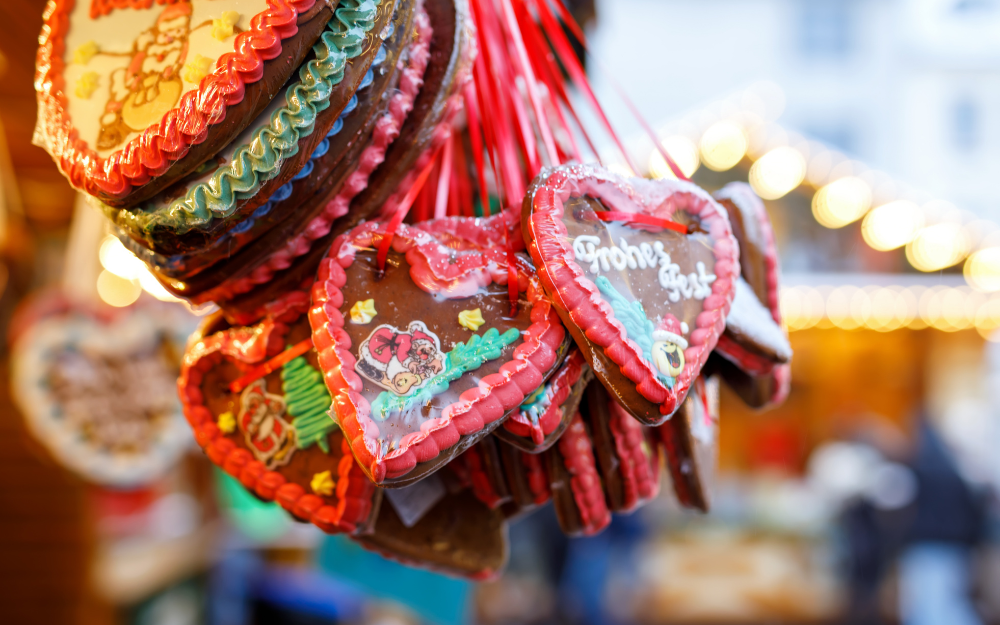
You will also see the big decorated heart-shaped ones hanging on ribbons at markets and fairs. Those are Lebkuchenherzen, they are piped with messages, and many stalls will ice a name onto one while you wait. They are more keepsake than snack. The edible ones come in tins.
9. Meissen Porcelain

By Carole from Travels with Carole
They called it white gold, and the price still reflects that. German porcelain makes a wonderful souvenir if your budget stretches to it. My own preference is a hand-painted cup and saucer to drink tea from each morning, though there is plenty else to choose from: sugar bowls, serving plates, figurines.
Europe’s first hard-paste porcelain was produced at Meissen in 1708, and the state manufactory was founded there in 1710, making it the oldest in Europe. The town sits about 25 kilometres downriver from Dresden, half an hour along the Elbe, and an excursion out to choose your own piece is the best way to do it. There is a guided tour with workshop demonstrations and a museum, and the café serves on Meissen porcelain.
Best of all is the outlet store, though even at outlet prices it is not cheap. The shop will pack your selection securely or ship it home for you, which for anything larger than a cup is money well spent.
10. A Solingen Knife
Solingen is called the City of Blades, and unlike most nicknames of that sort it has legal force behind it. The name Solingen is protected for cutlery, which means a knife or a pair of scissors can only carry it if essentially all of the work, the forging, the grinding and the finishing, happened inside the city limits. It is the same principle as Champagne, applied to steel.
The two names most people know are Zwilling J.A. Henckels, registered in 1731 and one of the oldest continuously operating companies anywhere, and Wüsthof, founded in 1814 and still in the same family seven generations on. Both still forge in Solingen. Beyond them are Böker for pocket and hunting knives and Dovo for razors and grooming tools, which are the ones to look at if you want something less obvious.
A single forged chef’s knife is the buy. It is the piece you will use every day for twenty years, prices in Germany are usually better than at home, and it packs flat in checked luggage. Nail scissors and grooming sets are the cheap version of the same idea and make good small gifts.
💡 Insider Tip: Knives cannot go in hand luggage, so this one has to travel in the hold. If you are flying with cabin bags only, most Solingen makers will ship, and the department stores will usually arrange it.
11. A Steiff Bear
The teddy bear was invented in Germany, in a small town in Swabia called Giengen an der Brenz, and the company that did it is still there.
Margarete Steiff contracted polio as a toddler and used a wheelchair for the rest of her life. She trained as a seamstress, started making felt clothing, and in 1880 turned a small felt elephant she had been making as a pincushion into a toy. In 1902 her nephew Richard designed a jointed plush bear with movable arms and legs. Margarete thought it would not sell. An American buyer at the Leipzig toy fair ordered three thousand of them, and by 1907 the Giengen factory was producing close to a million bears a year.
Every genuine Steiff animal since 1904 carries a small metal button in its ear, the Knopf im Ohr, which the company introduced specifically to stop imitators. It is still there, and it is still the way you tell a real one.
They are not cheap, and they are not meant to be. A small classic bear runs into the tens of euros and the limited editions go far higher. But it is one of the few souvenirs on this list that a child will still have as an adult. The Steiff Museum in Giengen has a factory viewing workshop and several thousand animals on display if you are anywhere near Ulm.
12. Anything with the Ampelmann on It

By Ali from Berlin Travel Tips
If your trip brings you to Berlin, one of the more interesting souvenirs from Berlin is anything carrying the Ampelmann, sold at the Ampelmann stores around the city.
The Ampelmann is the East Berlin pedestrian crossing figure, and it has become a symbol of the city. When Berlin was divided, each side ended up with its own design for the little red and green men on the crossing signals. After the Wall came down the eastern version was nearly phased out, until a designer took a liking to it, tracked down the original inventor, and the two worked together to keep it alive. The first Ampelmann store followed.
There are several shops in the city now, and the range goes well beyond the obvious. T-shirts, magnets, mugs and bags, yes, but also beach chairs, bath towels, stationery, lamps, and Ampelmann-shaped pasta and sweets. You will find some items with the Ampelfrau, the female version, too.
Most of it is small and packs flat, which makes this the easiest entry on the list to actually get home.
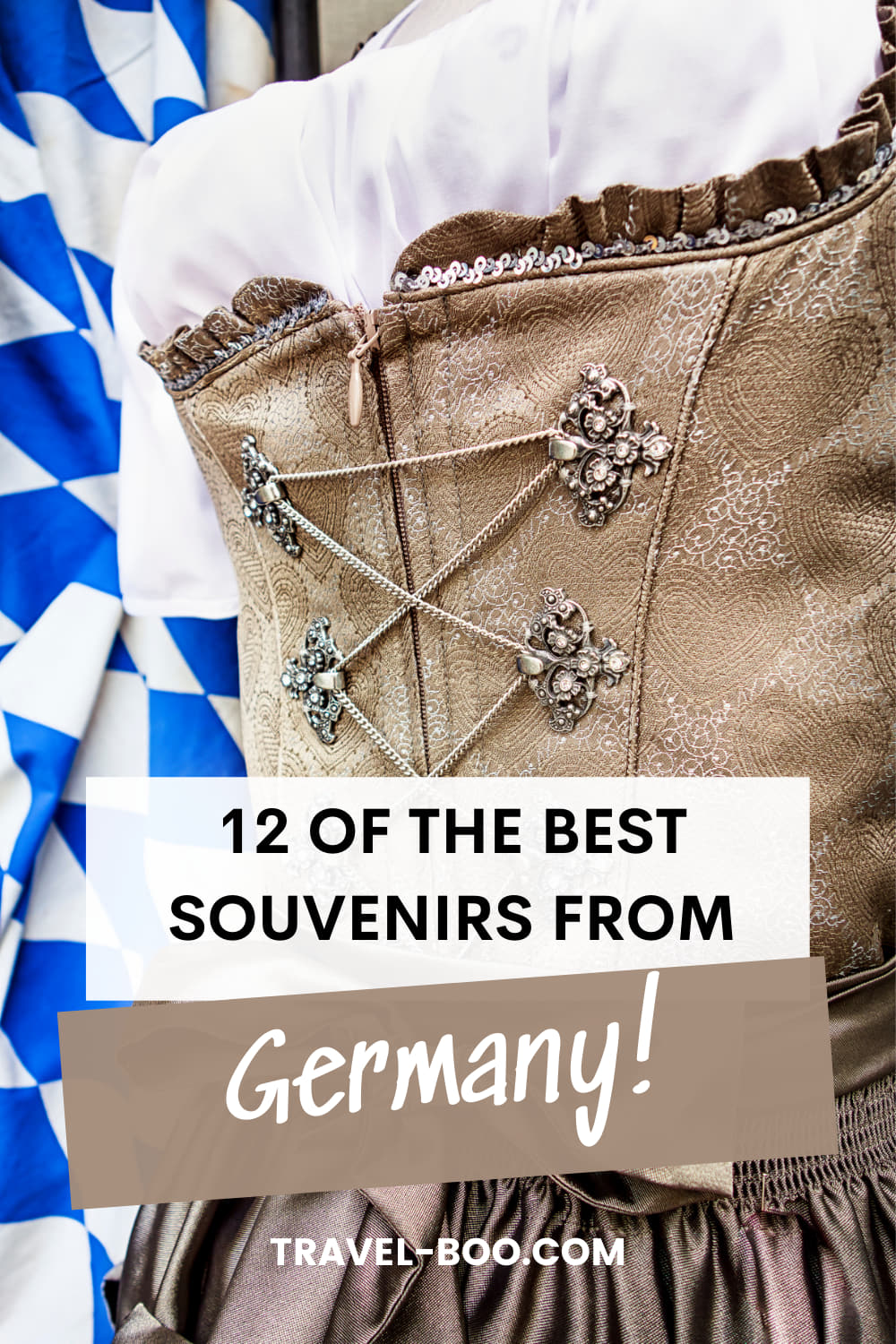
13. A Dirndl or Lederhosen

By Melissa from Parenthood and Passports
Probably the most recognisable national dress in the world, and a genuinely good souvenir if you buy properly. The costumes are most associated with Oktoberfest in Munich, but it is not unusual to see people wearing them in Bavaria at weekends, weddings and parties.
A dirndl is a ruffled dress made up of a blouse, a bodice and an apron skirt. Lederhosen are knee-length leather shorts, usually worn with suspenders, a white or checked shirt and wool socks. Both date to the eighteenth century and both are still worn in Munich and across the surrounding Bavarian region.
Boutiques and larger department stores throughout the region sell them. Authentic pieces are not cheap, and the leather ones in particular are an investment, but they are made to last decades rather than seasons.
14. Zwetschgenmännle, the Prune People
By Laura from Travelers Universe
Zwetschgenmännle are little figures made from dried prunes, sold at German and other European Christmas markets. They come from Nuremberg originally, and they are a small, light souvenir that takes up almost no room in a suitcase.
There are hundreds of variations, from the classic chimney sweeps to kissing couples, guitar players, travellers, cooks, waiters and most other professions, so you can pick something that suits whoever you are buying for.
They last for years, and they are said to bring good luck. If one turns slightly grey over time that is sugar rather than mould, and it comes off with a little alcohol.
The story goes that they date back to the eighteenth century, when a father wanted to give his children something for Christmas and had only wire and dried prunes to work with.
15. Halloren Chocolate

By Annemarie from Travel on the Brain
If you are a foodie you cannot skip German chocolate, and there are more traditional brands to work through than one trip allows. One of the most famous comes from the oldest chocolate factory in the country: Halloren, in Halle.
The Halloren Kugeln are round pralines with a crisp chocolate shell and two creamy fillings inside, never liquid. There is a long list of flavours and they run limited editions too, including liqueur, banana split and chocolate mousse. The classic cream cocoa (Sahne-Cacao) is the one to start with. It does not miss.
You can pick them up in supermarkets like Kaufland, or visit the factory in Halle itself, which has a chocolate museum attached. If you are there in December, look for the winter edition and pair the trip with the Leipzig Christmas market, which is half an hour away and one of the oldest in Germany.
They make a good gift because they are easy to share, they do not melt readily, and the box itself is sturdy enough to survive a suitcase and smart enough to hand over as is.
16. Birkenstocks
People forget Birkenstock is German. The family have been shoemakers since 1774 and the contoured cork footbed that made the brand was developed in the 1890s, long before anyone thought of them as fashion.
Buying them in Germany gets you a wider range of models, colours and widths than most countries stock, and often at better prices, particularly in department stores and dedicated shoe shops rather than tourist areas. Sizes are in European numbering and the regular and narrow widths are both readily available, which is not always the case abroad.
Not the most romantic thing on this list, but it is the one you will use most.
💡 Insider Tip: If you live outside the EU, you can usually claim the VAT back on larger purchases like clothing, shoes or porcelain. Ask the shop for a tax-free form at the till, keep the goods unused, and get the form stamped at customs before you check in for your flight home. It is worth doing on anything over a hundred euros or so.
17. A German Supermarket Haul

Haribo section by Erie from Everywhere Ontario
Haribo might be the tastiest thing you bring back from Germany. The company started in a small family kitchen in Bonn in 1920 and invented the gummy bear a couple of years later, so this is genuinely a German original rather than a global brand that happens to be sold there.
You are right to wonder why you would carry gummy bears home when you can buy them anywhere. The answer is the flavours. German supermarkets stock varieties that never leave the country: Salz Brezeln, which are salty-pretzel gummies, seasonal Frohe Weihnachten Christmas mixes, and a rotating cast of limited editions alongside the standard Goldbären.
While you are in there, the same logic applies to the rest of the aisle. Ritter Sport does flavours for the domestic market that never get exported. Kinder Riegel and Hanuta are childhood staples for anyone who grew up in Germany. Leibniz butter biscuits come in tins that look better than they have any right to. And Aachener Printen, a harder spiced biscuit from Aachen, is protected by EU origin rules the same way Lübeck marzipan is.
Twenty euros in a German supermarket produces a better set of gifts than most souvenir shops manage for triple that, and it all packs flat.
18. A Piece of the Berlin Wall

By Chris from Around The World With Me
Souvenir shops across Berlin sell small chunks of graffitied concrete in little display cases, labelled as pieces of the Berlin Wall. They start at around ten euros. The obvious assumption is that this is a tourist scam, and the obvious assumption is mostly wrong.
The concrete is usually genuine. Most of what is sold in the city comes from a family firm in the Reinickendorf district, which has been at this since 1992, when a relative acquired a stock of intact wall segments and started breaking them down. They still have around forty sections in storage, thirty of them whole. Pieces start at about ten euros with a certificate of authenticity, and their customers include the German parliament. When a Berlin magazine had fragments from city souvenir shops independently tested, almost every one came back authentic.
The paint is the part that is not original. Almost all the real graffiti flaked off the concrete decades ago, so the bright colours on your souvenir were sprayed on in a workshop, recently. The suppliers say so openly on their own websites. It is an open secret in the trade and nobody is particularly troubled by it.
Fakes do exist, and they tend to be plaster rather than concrete. They turn up mostly on the cheap stalls around Checkpoint Charlie. If you want to be sure, look for pieces labelled Berliner Mauermanufaktur, or buy from the Berlin Wall Memorial gift shop or the Topography of Terror bookshop, where fragments come with proper provenance paperwork.
Buy one. It is genuinely a piece of the thing, which is more than most souvenirs can claim, and about ten euros is a fair price for holding a bit of the twentieth century in your hand. Just do not pay a premium believing the graffiti is original, and if someone tells you their piece is the one Bowie leaned on, there is a well-worn Berlin line that if every fragment ever sold were real you could rebuild the Wall several times over.
💡 Insider Tip: Go and see the real thing while you are there. The East Side Gallery is a 1.3 kilometre stretch of original Wall along the Spree, painted as an open-air mural in 1990 and still standing. The shop at the eastern end sells prints of the artworks. Skip the stalls along the street outside, which sell mass-produced posters with no connection to the artists.
Find Your Base in Germany
🏨 Compare hotels and apartments across Germany on Stay22, which pulls live prices from Booking.com and other providers so you can see the whole picture on one map.
Souvenirs from Germany: FAQs
What is the most popular souvenir from Germany?
Beer steins and Christmas market mugs are the two most commonly bought souvenirs from Germany. The mug has the edge for value, since you only pay the small deposit and each market designs its own, so no two are alike. Cuckoo clocks are the most popular higher-value purchase.
What food can I bring back from Germany?
Chocolate, Lebkuchen, Lübeck marzipan and German sweets all travel well and are fine to bring into the UK, EU and most other destinations. Meat and dairy products face restrictions when entering many countries including the UK and the US, so check your own customs rules before packing sausage or cheese.
Where is the best place to buy souvenirs in Germany?
It depends what you are after. Christmas markets between late November and Christmas are unbeatable for wooden decorations, mugs and Lebkuchen. Otherwise buy at the source: Triberg for cuckoo clocks, Meissen for porcelain, Cologne for eau de cologne, Seiffen for Erzgebirge woodwork. For everyday gifts, a large supermarket beats a souvenir shop on both price and originality.
How do I know if a cuckoo clock is genuine?
Look for the VdS certificate from the Black Forest Clock Association, which confirms the clock was made in the region. Genuine sellers display the mark and provide the paperwork. Be wary of very cheap clocks in tourist areas, which are usually imported and relabelled.
What does Trocken mean on a German wine label?
Trocken means dry. Halbtrocken means off-dry, and Feinherb is an informal term for something in between. These are separate from the Prädikat terms (Kabinett, Spätlese, Auslese), which describe how ripe the grapes were at harvest rather than how sweet the finished wine tastes. A Spätlese labelled Trocken is a dry wine.
Are the pieces of the Berlin Wall sold in shops real?
The concrete usually is. Most fragments sold in Berlin come from suppliers who acquired intact wall segments in the early 1990s and break them down for sale, and they come with certificates of authenticity. The graffiti, however, is almost always sprayed on afterwards, because the original paint flaked off long ago. Plaster fakes exist, mainly at cheap stalls around Checkpoint Charlie, so look for pieces labelled Berliner Mauermanufaktur or buy from the Berlin Wall Memorial gift shop.
Can I claim VAT back on souvenirs bought in Germany?
If you live outside the EU, yes, on most goods above a minimum spend. Ask for a tax-free form at the till, keep the items unused and in their packaging, and get the form stamped at customs at the airport before checking in. It is generally worth the paperwork on purchases over about a hundred euros.
Before You Go
One practical thing worth thinking about before you fly out: almost everything on this list is either fragile, edible or bulkier than it looks. Leave some room, and if you are travelling hand luggage only, plan around the mugs and the porcelain rather than hoping for the best at the gate.
Our Europe packing list covers the rest of it, and if Germany is one stop on a longer trip, the Portugal and Spain souvenir guides work the same way as this one.